
For years, so much of fitness has been focused on weight loss.
Get lighter. Eat less. Burn more calories. Watch the number on the scales.
And although body weight can be useful information, I think we place far too much importance on it.
As I’ve got older, my own priorities have changed a lot.
I’m far less interested now in simply being lighter. I care much more about being strong, capable, mobile and keeping as much muscle as possible.
That shift has completely changed the way I train.
I still want to look good. Of course I do. But I also want to feel strong in my body. I want to be able to lift, move, ride, train and keep doing the things I love for as long as possible.
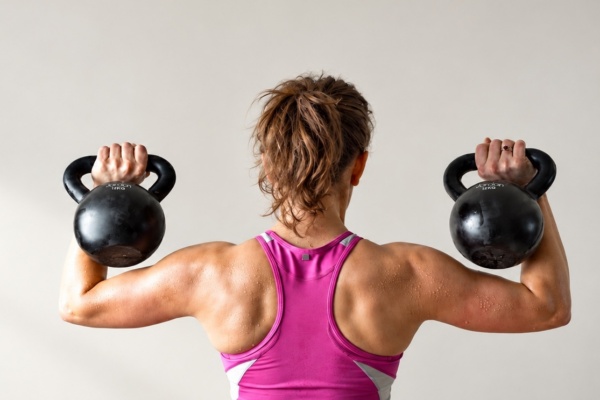
That is one of the reasons I absolutely love kettlebells.
There is something about kettlebell training that I really enjoy. It is strong, powerful, functional training and it works the whole body.
You can squat with them, press them, swing them, carry them, row them and use them in so many different ways.
They are brilliant for building strength, improving fitness, working the core and challenging coordination as well.
And one of the things I particularly love is kettlebell flow.
Although I use the word “love” loosely sometimes, because kettlebell flow can be incredibly taxing, both physically and mentally.
The flow in the video at the bottom of this blog took me weeks to learn properly.
I would go to bed thinking about it, get up the next morning and practise the sequence without a weight, then keep repeating it until my brain and body finally started working together.
That is something I relate to with a lot of my clients too.
Sometimes the hardest part of an exercise is not strength or fitness. It is thinking and doing at the same time.
Remembering the sequence. Coordinating the movement. Getting your body to do what your brain is asking.
That can be a workout in itself.
But I actually think that is part of what makes it so valuable.
Kettlebell flows challenge coordination, concentration, balance, timing, strength and cardiovascular fitness all at once.
And I suppose anything that makes both the brain and the body work a little harder has to be a good thing.
It also reminds me that learning something new does not always happen quickly.
Sometimes you have to break it down, practise it slowly, take the weight away, repeat it over and over and give your brain time to learn the pattern.
That applies just as much to my own training as it does to the people I train.
For a lot of people, fitness can become too focused on trying to get smaller or lighter.
A smaller waist. A smaller dress or trouser size. A lower number on the scales.
But there comes a point where I think we need to change the conversation.
Instead of constantly asking, “How much weight have I lost?” perhaps we should also be asking:
Am I stronger?
Am I moving better?
Do I feel more confident?
Can I lift more?
Do everyday tasks feel easier?
Am I maintaining muscle?
Do I feel more capable in my own body?
Because those things matter enormously.
Muscle gives the body shape. It helps us stay strong and stable, supports our joints and bones and plays a huge role in how capable we remain as we get older.
Losing weight without maintaining muscle is not always the win people think it is.
Someone can be lighter but weaker.
They can weigh less but have less muscle, less strength and less confidence in how their body moves.
That is why I increasingly prefer to focus on body composition and strength rather than simply scale weight.
And this is something I talk to clients about all the time.
The scales are one measurement.
They are not the whole story.
If your clothes fit differently, you are stronger, your posture has improved, your body feels firmer, you are moving better and your confidence is growing, that is progress.
Sometimes very significant progress.
As we get older, this becomes even more important.
Recovery changes. Our bodies change. Maintaining muscle matters more. Strength matters more. Mobility matters more.
And I don’t believe the answer is to spend our lives chasing the lowest possible number on the scales.
I would much rather see people building strong bodies they feel confident in.
That does not mean weight loss is wrong.
Some people absolutely want to lose weight, and there is nothing wrong with that.
But I think the goal should be bigger than simply seeing a lower number.
For me now, training is about longevity, strength, independence, confidence and still being able to do the things I love.
It is about maintaining muscle.
It is about feeling powerful in my own body.
And yes, it is also about enjoying the process.
Which is exactly why you will so often find me with a kettlebell in my hand.
For me, getting stronger matters far more than simply getting lighter.